
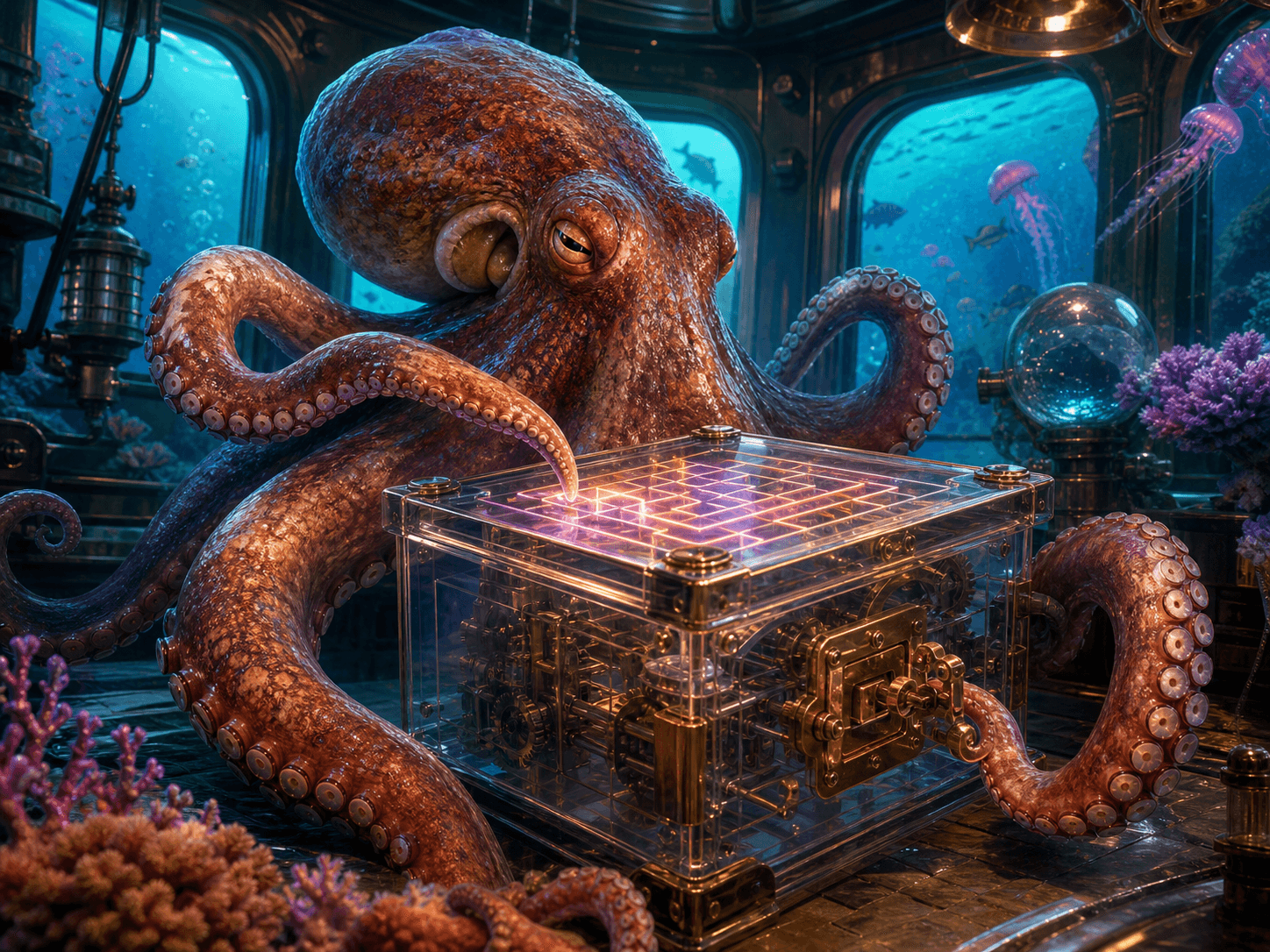
Octopuses have large, complex nervous systems and have repeatedly solved mazes, opened containers and learned from experience in laboratory studies. Their intelligence is very different from ours: much of their neural processing is distributed through their arms. Scientists avoid ranking animal minds on one human-style scale, but the evidence clearly shows flexible problem-solving and memory.
What we found
Octopuses are not simply acting on fixed reflexes. Experiments and field observations show exploration, learning and memory. Each arm contains many neurons, while the central brain coordinates the animal. That unusual design helps an octopus manipulate objects and adapt its behaviour. Researchers still debate how octopus awareness should be described, so the careful conclusion is that they are capable problem-solvers rather than “underwater humans.” The Ridbusters then compare the wording with the original sources, look for the conditions of each observation and check whether another explanation could fit. That turns a surprising headline into a trail a young investigator can follow: claim, test, result and remaining uncertainty. Octopuses have large, complex nervous systems and have repeatedly solved mazes, opened containers and learned from experience in laboratory studies.